BRS&S Tax & Customs Practice Continue Recognition in The Legal 500 Asia Pacific (2026)

Blumenthal Richter Sumet & Schuler continues to receive recognition in Tax (Tier 2) in The Legal 500 Asia-Pacific 2026 rankings for Thailand, highlighting the strength, experience, challenge, and growing market recognition of the firm’s tax and customs practice, as well as that of its individual lawyers. This is the twelfth year in which the Tax & Customs Practice has received this recognition.

Our Tax & Customs practice is led by Senior Partner Sumet Mingmongkolmitr, who has once again been recognized as a Leading Partner (six-year listing), reflecting his longstanding reputation for advising on and managing the full range of Tax & Customs matters, particularly complex matters involving regulatory, practical, investigation, and cross-border issues.

The firm is also pleased to see Partner Promboon Sookatup, who handles tax aspects of M&A deals, ranked as a Next Generation Partner in M&A tax area. Her practice focuses on tax optimization strategies for buyers and sellers engaged in entire business transfers, asset purchases, share acquisitions, and joint ventures. This distinction reflects her increasingly prominent role in M&A tax area.

At the Associate level, Senior Associate Sudarat Jirakietwattana continues to gain market recognition, being ranked as a Recommended Lawyer (first-year listing) and further recognized as a Leading Associate (second-year listing) Legal 500’s editorial commentary highlights Sudarat as “a name to note,” underscoring her growing profile and consistent involvement in key matters for both domestic and international clients.

Senior Associate Chawin Luangpattarawong has also received first-time recognition as a Recommended Lawyer in Tax, marking an important milestone and reflecting his contributions to tax work in M&A transactions.

Client feedback published by The Legal 500 further reinforces the strength of the team, with clients commenting: “They are prompt in corresponding with us,” and “Good coordination with the team.”

The Legal 500 Asia-Pacific rankings are based on extensive independent research, including client interviews and detailed submissions of recent work and experience. The guide is widely regarded as one of the most authoritative assessments of law firm capabilities across the region.


Blumenthal Richter Sumet & Schuler Achieves Multiple Rankings in The Legal 500 Asia-Pacific 2026

Blumenthal Richter Sumet & Schuler is pleased to announce its recognition across three practice areas in The Legal 500 Asia-Pacific 2026 guide for Thailand, with 9 lawyers receiving individual honors.

Our firm has been ranked in the following practice areas: Tax (Tier 2), Corporate/M&A (Tier 3), and Real Estate (Tier 3).

The firm’s achievement is further highlighted by the recognition of several lawyers for their outstanding work. Senior Partner Sumet Mingmongkolmitr has been recognized as a Leading Partner in Tax practice for the 6th time, while Senior Partner Robert Schuler has been recognized as a Leading Partner in Real Estate practice for the 5th  time.

Moreover, Promboon is further ranked as a Next Generation Partner in Tax practice while Senior Associates Sudarat Jirakietwattana and Chawin Luangpattarawong (first-time ranked) have been noted as Recommended Lawyers. Sudarat is further noted as a Leading Associate.

In Corporate/M&A practice, Senior Partner Andreas Richter, Partner Ekkarat Ritthiplang, Partner Stefan Riedl (first-time ranked), Partner Promboon Sookatup (first-time ranked) and Senior Associate Jatuporn Pakornrat (first-time ranked) have been noted as Recommended Lawyers.

Commenting on the rankings, Sumet stated: “We are extremely proud that this represents the highest number of Legal 500 rankings our firm has ever achieved. It is particularly gratifying to see many new faces being recognized for the first time, which speaks to the strength and development of talent across our practice groups.”

The Legal 500 Asia-Pacific rankings are based on extensive research, including client feedback and submissions detailing recent work and achievements. The guide is recognized globally as a leading independent assessment of law firm capabilities.

Thailand’s Top-up Tax: Potential Policy Directions and Regulatory Changes from the BOI and the Revenue Department

Sumet Mingmongkolmitr (Senior Partner)

On January 1, 2025, Thailand’s Revenue Department began enforcing the Emergency Decree on Top-up Tax B.E. 2567 (2024), marking a significant step for Thailand toward implementing the OECD’s Global Anti-Base Erosion Model Rules under Pillar Two. This issuance aims to reduce tax competitions among countries by ensuring that in-scope multinational enterprise (MNE) groups are subject to an effective tax rate (ETR) of at least 15%.

Under this Emergency Decree, Thailand’s Revenue Department is authorized to collect Top-up Tax from MNEs operating in Thailand where the applicable ETR falls below the minimum threshold. This introduction may inevitably raise concerns among MNEs that have benefited under Thailand’s Board of Investment (BOI) as the BOI-granted tax incentives may trigger additional Top-up Tax liabilities.

In response, on November 12, 2025, the BOI, in collaboration with the Ministry of Finance, announced that it is in the process of revising the National Competitiveness Enhancement for Targeted Industries Act B.E. 2560 (2017) by introducing a Qualified Refundable Tax Credit (QRTC), which is a mechanism recognized by the OECD. This new form of incentive reflects a policy response aimed at aligning Thailand’s investment promotion regime with the OECD’s global minimum tax framework. However, this incentive is intended to be offered as an alternative measure for MNEs affected by the Emergency Decree, not to replace the offering of incentives. This means that investors who are not subject to the Emergency Decree can continuously benefit from the BOI-granted incentives as in the past.

Furthermore, on December 30, 2025, Thailand’s Cabinet approved four draft secondary legislations issued in pursuance to the Emergency Decree, which were developed in accordance with the OECD’s GloBE Model Rules and Commentaries, with the objectives of ensuring consistency with the international practices. The approved drafts address the detailed rules, including but not limited to the determination of in-scope MNEs and the approach for calculating Top-up Tax liabilities that such taxpayers are subject to under the Emergency Decree. The four draft laws are as follows:

  1. Royal Decree prescribing the criteria for determining whether multinational enterprise groups that have undergone organizational restructuring are subject to the Top-up Tax;
  2. Ministerial Regulation prescribing the criteria concerning entities that are not constituent entities;
  3. Ministerial Regulation prescribing the criteria for allocating Top-up Tax to Thailand under the Undertaxed Payments Rule (UTPR) mechanism in cases where no constituent enterprise group located in Thailand has GloBE income; and
  4. Ministerial Regulation prescribing the criteria for adjusting income, expenses, and covered taxes for the calculation of the Top-up Tax, including the criteria for calculating the Domestic Top-up Tax in Thailand.

Overall, these developments signal Thailand’s progress toward implementing the global minimum tax framework. However, further updates on their key aspects will be provided once the detailed rules become available.

Getting Customs Valuation Right: How Discounts Affect Import Declarations in Thailand

Sumet Mingmongkolmitr (Senior Partner)

In today’s global economy, commercial transactions increasingly cross geographic boundaries. For Thai or multinational companies operating in Thailand, importing goods, products, or raw materials from abroad for business use or trade has become standard practice.

The rising and increasing volume of import transactions naturally heightens the risk of facing legal and customs -related issues. One such example occurs when imported goods are found to contain defects. Instead of returning or exchanging these items, which may not be cost-effective, the supplier might offer a discount on a future order as compensation. This situation raises an important question in the import process in Thailand: What product price should be declared in the import declaration at Customs when such discounts are involved?

Under the Thai Customs Procedures, importers must declare the transaction value in their import declaration, which customs duties are then calculated and paid. In practice, some importers declare a value after deducting supplier-provided discounts, and Thai customs officials usually accept these declarations without issues. However, in other cases, customs officials may request the importers to use the original product price (before discount) as the transaction value, on the basis that the type of discount does not criteria under the relevant Thai customs regulations.

Therefore, importers need to carefully consider discounts when submitting import declarations. Not all discounts are eligible for deduction, as eligibility depends on factors such as the nature of the discount, the type of goods, and the value or quantity of the involved products.

Blumenthal Richter Sumet & Schuler Receives Three Practice Area Rankings and Two Individual Rankings in Chambers & Partners Asia-Pacific Guide 2026

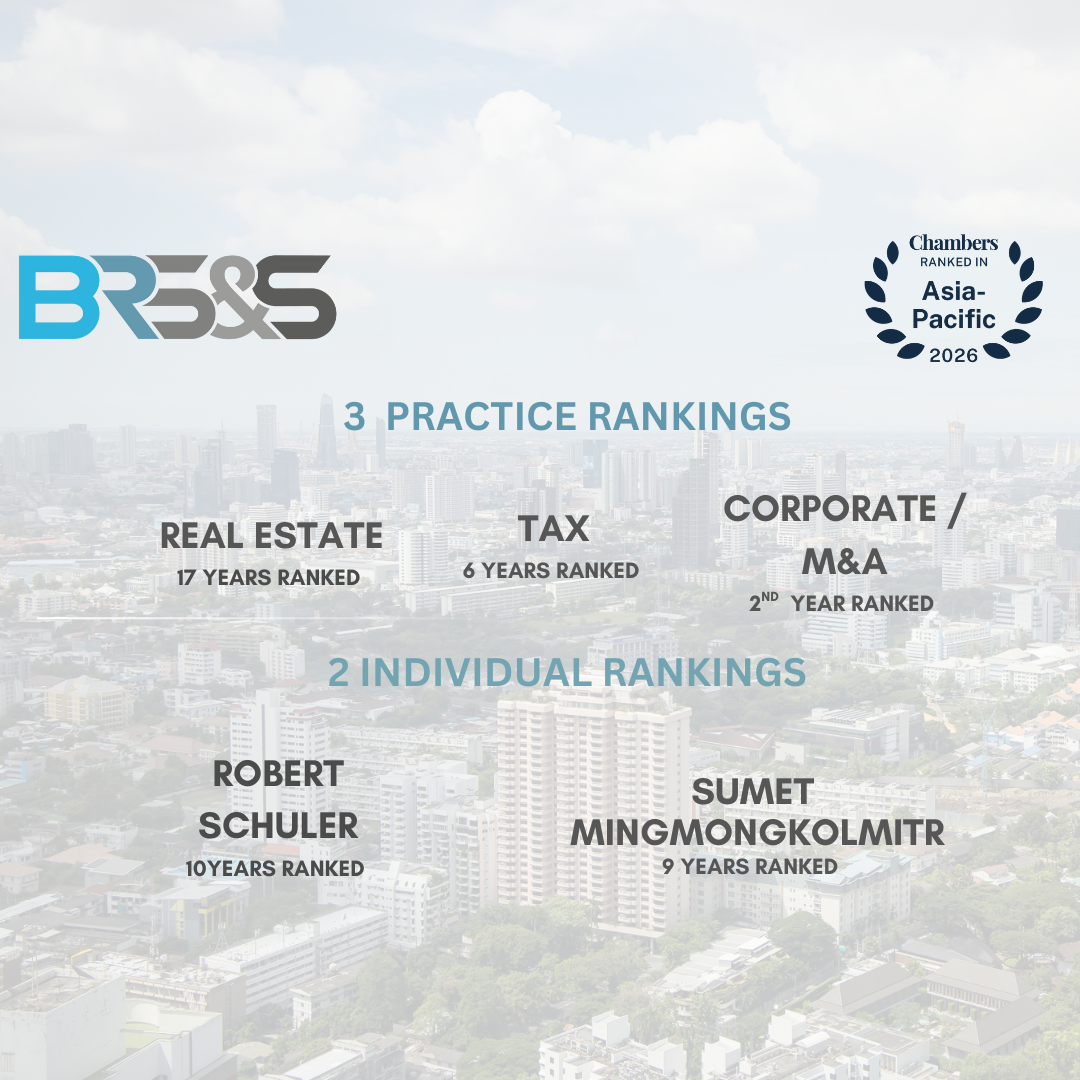
Blumenthal Richter Sumet & Schuler is pleased to share that our firm has been recognized with three practice area rankings and two individual lawyer rankings in the recently released Chambers & Partners Asia-Pacific Guide 2026.

Our firm received recognition in the following practice areas:

  • Real Estate — Led by Senior Partner Robert Schuler and Partner Weerasa Makepongtorn, the practice was ranked for the seventeenth consecutive year and is currently recognized as a Band 2 practice, reaffirming the firm’s longstanding leadership in the Thai real estate market.
  • Tax — Led by Senior Partner Sumet Mingmongkolmitr and Partner Promboon Sookatup, the practice earned its sixth listing in this directory and is currently recognized as a Band 2 practice, highlighting its strength in complex tax and customs matters.
  • Corporate / M&A — Led by Senior Partner Andreas Richter and Partners Stefan Riedl and Ekkarat Ritthiplang, the practice was recognized for the second consecutive year and is currently recognized as a Band 5 practice, reflecting the team’s growing market presence and deal-making capability.

In addition, two of our practitioners received individual distinctions:

  • Robert Schuler, Head of Real Estate & Hospitality Practice, was individually ranked for the tenth time, reflecting his continued reputation as a leading practitioner in Thailand.
  • Sumet Mingmongkolmitr, Head of Tax & Customs Practice, was individually ranked for the ninth time, further underscoring his standing as a trusted advisor on complex tax and customs matters.

Chambers & Partners is one of the world’s most respected legal directories, ranking law firms and lawyers across more than 200 jurisdictions based on in-depth research, client feedback, and independent market analysis. Its annual rankings are widely regarded as a benchmark for excellence in the global legal industry.

These recognitions come after a year of historic growth for the firm. Blumenthal Richter Sumet & Schuler recently relocated to its new premises at One Bangkok to accommodate its expanding team and service offerings, including the acquisition of another firm that strengthened its multi-disciplinary capabilities.


BRS&S’ Ekkarat Ritthiplang Recognized as a Rising Star Partner in IFLR 1000

Blumenthal Richter Sumet & Schuler is proud to announce that Partner Ekkarat Ritthiplang has been recognized as a Rising Star Partner in M&A in the 35th edition of the International Financial Law Review 1000, the global guide to the world’s leading financial and corporate law firms. This recognition highlights Ekkarat’s growing influence in Thailand’s corporate legal market and his role as a next-generation leader within the firm.

Promoted to the partnership in 2024, Ekkarat continues to deliver exceptional services to the firm’s clients, with a particular focus on the automotive, renewable energies and manufacturing sector. In these core industries, he has played a pivotal role in advising multinational and domestic clients on complex corporate transactions, including mergers and acquisitions, joint ventures, and cross-border investment projects. His deep understanding of regulatory frameworks, combined with his ability to structure and negotiate deals efficiently, helped clients achieve strategic objectives while effectively managing risk.

At the same time, Ekkarat is establishing  a distinctive niche in Thailand’s rapidly evolving fintech and digital payments sector. He advises both emerging and established companies on corporate structuring, regulatory compliance, licensing, and investment matters in a market defined by dynamic and evolving regulations. His work often involves close coordinating with the Board of Investment, the Bank of Thailand, and other regulatory bodies to ensure clients can pursue innovation while remaining fully compliant. By combining traditional corporate and transactional expertise with a forward-looking understanding of digital finance, Ekkarat helps clients capture growth opportunities and structure secure, efficient transactions in this  fast-growing sector.

Being named a Rising Star Partner reflects Ekkarat’s emerging leadership within the firm and the wider legal community. This recognition is reserved for lawyers who, while still early in their partnership careers, demonstrate exceptional technical ability, market influence, and innovative client service. It underscores his potential to shape the firm’s future and contribute meaningfully to Thailand’s corporate legal landscape.

The IFLR1000 is a leading international legal directory relied upon by in-house counsel, investors, and business leaders to identify top legal talent. It evaluates firms and practitioners based on deal complexity, innovation, and market impact, recognizing those who deliver exceptional in high-value transactions.

“Being recognized as a Rising Star Partner is a true honor,” said Ekkarat Ritthiplang. “It reflects the collaborative spirit of our team and the exciting opportunities within Thailand’s dynamic market. I remain committed to supporting our clients’ growth and to helping the firm expand into new areas of practice- especially as we embrace the digital and AI era”

This recognition underscores Blumenthal Richter Sumet & Schuler’s dedication to nurturing the next generation of legal leadership, combining deep sector expertise with forward-looking vision to serve clients across traditional and emerging industries.

Andreas Richter, Senior Partner at Blumenthal Richter Sumet & Schuler, added: “Ekkarat’s recognition is very well deserved. His professionalism, client focus, and forward-looking perspective embody the values that drive our firm. We are proud to see his achievements recognized by IFLR1000.”

Blumenthal Richter Sumet & Schuler Achieves Continued Recognition in ITR World Tax 2026 Rankings

Blumenthal Richter Sumet & Schuler (BRS&S) is proud to announce that our Tax & Customs Practice has once again been recognized in the International Tax Review (ITR) World Tax 2026 rankings, marking another year of excellence and growth for the firm.

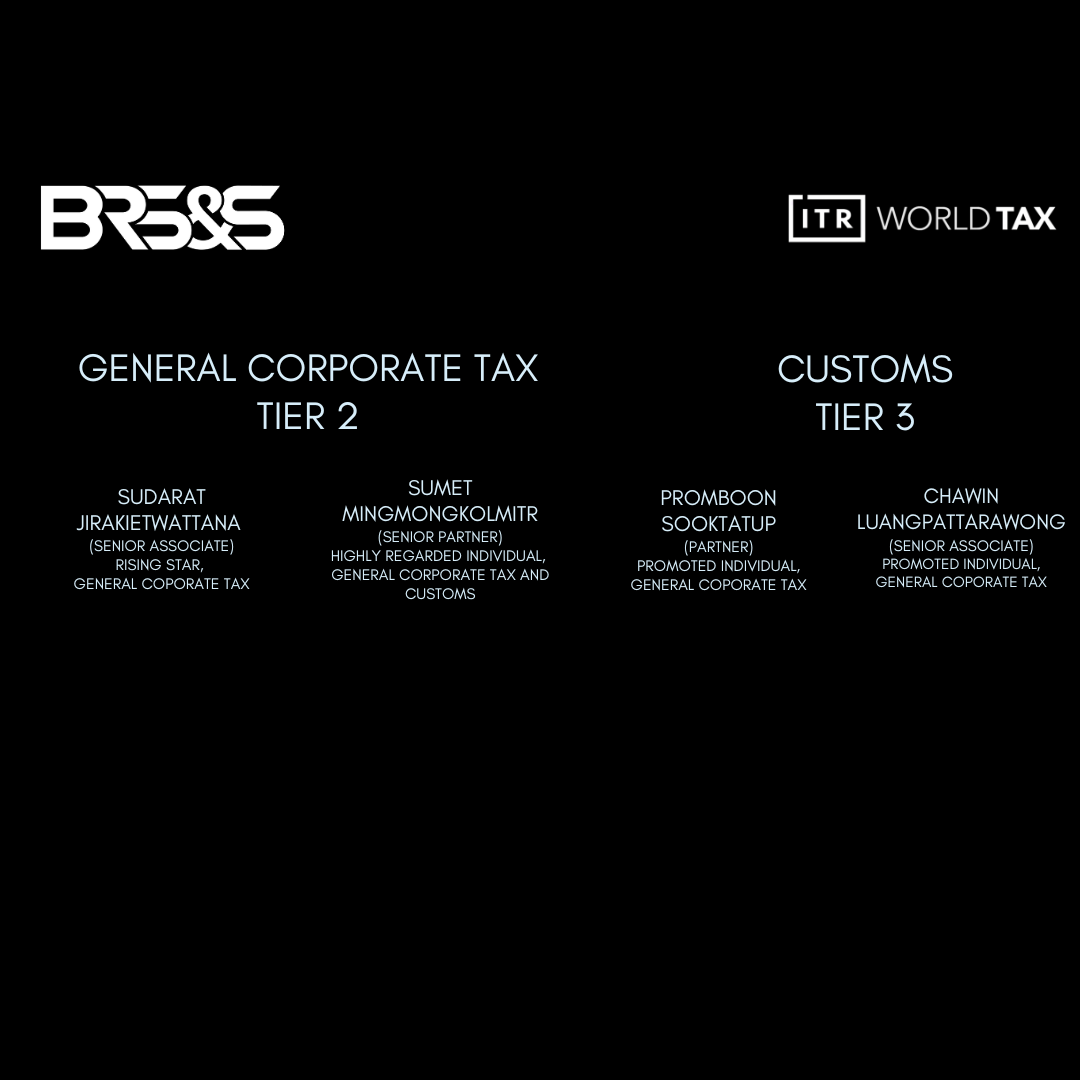
This year, we have received distinction as a Tier 2 firm in – General Corporate Tax and a Tier 3 firm in Customs.

These recognitions underscore the firm’s continued strength and commitment to providing sophisticated, practical tax and customs advice to high-net-worth individuals, investors, and multinational corporations doing business in Thailand.

At the individual level, Senior Partner Sumet Mingmongkolmitr, Head of the Tax & Customs Practice, continues to be recognized as a Highly Regarded Individual in both General Corporate Tax and Customs, reaffirming his longstanding reputation as one of the country’s foremost tax advisors.

We are also delighted to see Senior Associate Sudarat Jirakietwattana retain her recognition as a Rising Star in General Corporate Tax, a testament to her continued excellence and contribution to the practice.

In addition, this year marks the first-time recognitions of Partner Promboon Sookatup and Senior Associate Chawin Luangpattarawong, who joined the firm in 2024, as Promoted Individuals in General Corporate Tax — reflecting the firm’s ongoing investment in developing the next generation of tax leaders.

The ITR World Tax guide remains one of the most comprehensive and respected global resources for identifying leading tax firms and professionals. Covering over 155 jurisdictions worldwide, it reflects feedback from thousands of clients and practitioners, highlighting firms that consistently demonstrate expertise and client trust.

Under the guidance of Senior Partner Sumet and the collective effort of the entire team, BRS&S’  Tax & Customs Practice as well as our Tax / M&A Practice continues to expand its capability, experience, expertise, and client service — positioning the firm as a trusted advisor in the Thai tax area.

Tax Incentives for Employees Education and Training

Sumet Mingmolmolmitr (Senior Partner) 


Companies in Thailand are encouraged to support their employees in pursuing higher education or other training programmes. Such initiatives not only enhance employees’ skills but also strengthen the company’s long-term growth and profitability.

To promote this, the Revenue Department issued Order No. 122/2545, Re: Exemption of Income Tax Calculated from the Net Profit of Companies or Registered Partnerships Operating Businesses as Educational Institutions and Training Centres for Enhancing Employees’ Skills, and from Expenses on Education Purposes Made by Companies or Registered Partnerships dated 27 December 2002.

Deductible Expenses

Under this order, companies may fully deduct expenses incurred in supporting employees who:

  1. pursue further studies or training at public institutions or centres domestically or internationally;
  2. pursue further studies or training at private institutions or centres domestically or internationally; or
  • participate in in-house-training sessions organised by the company itself or by an external service provider.

These expenses are not considered prohibited under Section 65 Ter (13) of the Thai Revenue Code. To qualify for the deduction, however, the company must be able to demonstrate that the expenses were incurred for the company’s benefit, and the supported employees are required to return to work for the company.

Additional Tax Incentive

In addition, companies that provides financial support for employees to study or train at:

  1. government-established institutions or training centres, or
  2. institutions announced by the Ministry of Finance in the Royal Gazette,

are also eligible to fully claim a tax exemption on its income equal to the amount paid for the employees’ education or training. This incentive is granted under the Royal Decree issued pursuant to the Revenue Code Governing the Exemption from Revenue Taxes (No. 437) dated 15 October 2005.

These provisions highlight the Thai government’s commitment to encouraging workforce development while offering companies meaningful tax relief. To further navigate the rules and maximize available benefits, companies are encouraged to consult with a qualified tax counsel.

Blumenthal Richter & Sumet Achieves Repeat Recognition in IFLR1000

Blumenthal Richter & Sumet is pleased to share that four of its Partners have been recognized across two practice areas in the 35th edition of the IFLR1000, the guide to the world’s leading financial and corporate law firms.

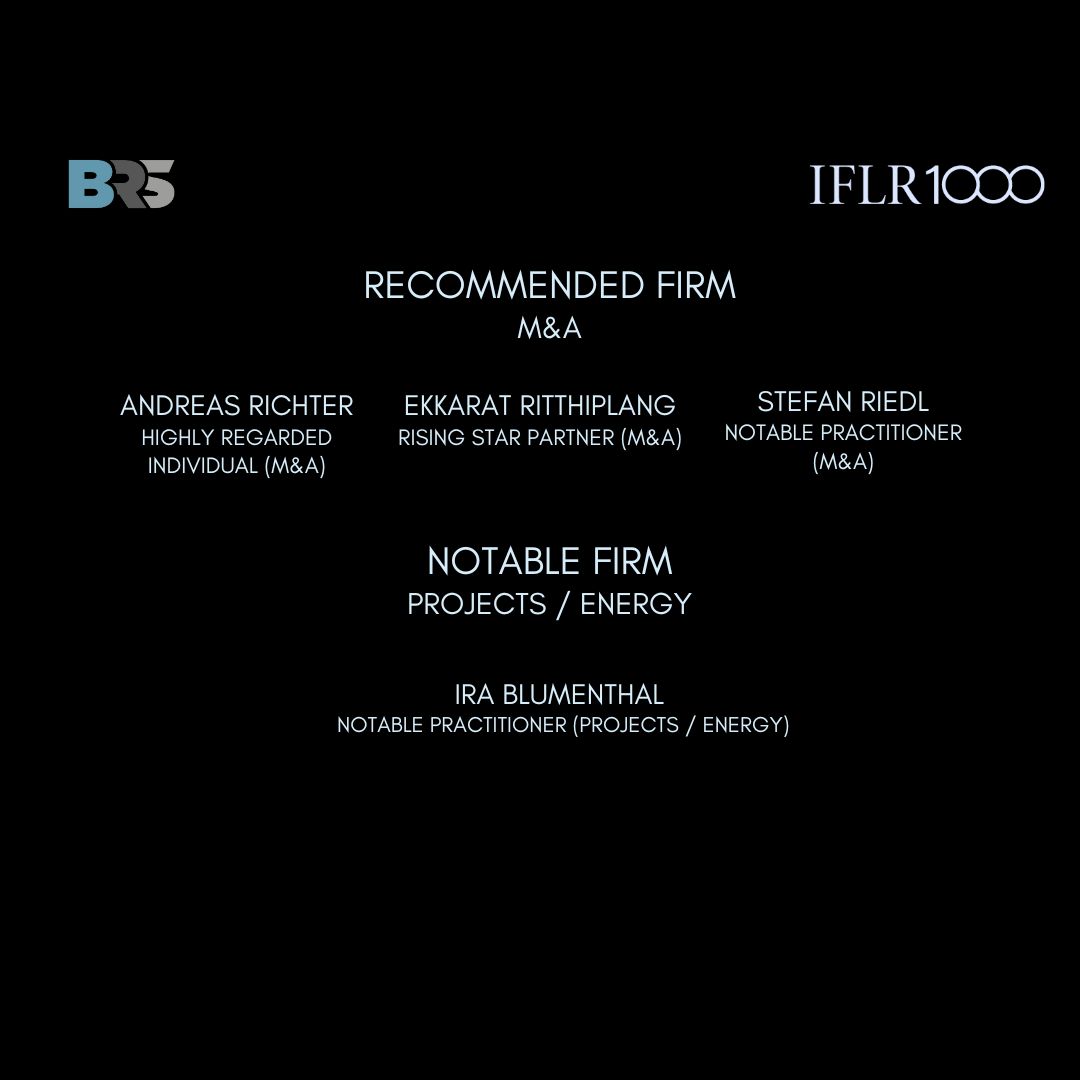
In the Corporate/M&A practice, the firm has been ranked as a Recommended Firm, with the following Partners individually recognized:

  • Andreas Richter, Senior Partner and Head of the Corporate/M&A Practice, was ranked for the second consecutive year as a Highly Regarded Individual, a distinction reserved for lawyers with a proven track record advising on complex and high-value transactions, acknowledged by clients and peers alike.
  • Stefan Riedl, Partner, was recognized as a Notable Practitioner in M&A, highlighting his experience in contract drafting, transaction structuring, and dispute resolution arising from corporate deals.
  • Ekkarat Ritthiplang, Partner, who was promoted to the partnership in 2024, was named a Rising Star Partner, reflecting his growing market profile and deep experience in Board of Investment matters and coordination with Thai government agencies.

In the Projects & Energy practice, Blumenthal Richter & Sumet was once again ranked as a Notable Firm. Ira Blumenthal, Senior Partner, was also recognized for the second consecutive year as a Notable Practitioner, underscoring the firm’s continued strength in complex energy and infrastructure mandates.

The IFLR1000 is a leading international legal directory relied upon by in-house counsel and business leaders to identify top legal talent. With its focus on transactional practices and its assessment of firms based on deal complexity, innovation, and market impact, these results reaffirm Blumenthal Richter & Sumet’s consistent standing as a trusted advisor in high-stakes, business-critical transactions.


Thailand Forms Task Force Ahead of U.S. Trade Tightening

Andreas Richter (Senior Partner) 

Overview

Thailand will establish a 50-member special task force in October 2025 to address the expected surge in certificates of origin required under new U.S. trade rules. The initiative comes as U.S. authorities step up scrutiny of Southeast Asian exports, particularly to prevent transshipment—including the re-routing of Chinese sourced goods through third countries without adding value to avoid higher tariffs.

Key Developments

  • Certificate Surge
    Thailand anticipates a dramatic increase in certificate of origin requests, rising from approximately 70,000 per year to several million.
  • Tariff Discrepancies
    While general tariffs on Thai exports to the U.S. have been adjusted downward to around 19% (from an earlier proposal of 36%), goods suspected of improper origin could face duties as high as 40%.
  • Trade Complexity
    The forthcoming U.S. measures will introduce stricter regional value-content requirements, require more extensive documentation, and intensify cost and origin verification. These rules remain under negotiation but signal a far more rigorous compliance environment.
  • Thailand’s Trade Profile
    In 2024, Thailand exported roughly USD 55 billion worth of goods to the U.S. while importing about USD 80 billion in goods from China—highlighting its position as a regional manufacturing hub heavily exposed to shifts in global supply chains.
  • Business Concerns
    Local industry leaders caution that the increased documentation and compliance burden could slow shipments and raise costs for exporters.

What This Means for Businesses

StakeholderImplications
ExportersAnticipate heavier administrative requirements; ensure full compliance with origin rules and value-added thresholds.
Supply ChainsRe-evaluate reliance on Chinese inputs and consider diversification or relocation of sourcing.
Trade CounselPrepare for enhanced verification measures; establish compliance protocols and audit procedures.
Customs & LogisticsScale up capacity to process higher certificate volumes; strengthen tracking and record-keeping systems.


Understanding “Transshipment” in International Trade

Definition:
Transshipment is the transfer of goods through an intermediate country before reaching the final destination. In logistics, it may involve changing vessels, shifting transport modes, or using hub ports to consolidate shipments.

Legitimate Uses:

  • Consolidating or breaking down shipments at a hub.
  • Switching modes of transport (e.g., ship to truck).
  • Routing through major hubs to reach remote markets.

Compliance Concerns:
In trade enforcement, transshipment also refers to routing goods through a third country with little or no substantial transformation to misrepresent their true origin. This practice is often used to bypass tariffs or quota restrictions.

U.S. trade authorities now treat such practices as high-risk for tariff evasion, triggering higher duties and intensified enforcement. Countries such as Thailand are under pressure to tighten customs oversight, enforce strict origin verification, and prevent misuse of transshipment channels.

Conclusion

Thailand’s decision to form a dedicated task force reflects the urgency of adapting to rapidly changing U.S. trade policies. Exporters and supply chain operators should act now to:

  • Strengthen compliance systems.
  • Reconsider sourcing strategies.
  • Prepare for detailed rules-of-origin verification.

Proactive steps today will help businesses safeguard market access and avoid costly disruptions as enforcement intensifies.

It has come to our attention that a phishing email falsely purporting to be a message from Blumenthal Richter & Sumet has been circulating.

What actions should you take:

  • Avoid interaction with any links or attachments in suspicious emails.
  • If a suspicious email has been received it should be immediately deleted.
  • Do not respond to the sender’s request for any personal information.

We are actively investigating this matter and have notified relevant local authorities. If you have any questions or need assistance, contact us at [email protected]. Thank you for your attention and cooperation.